Felice Hodges
 Vessels: Lapis Lazuli and Sky[in Singapore] Mixed media on canvas, 73 x 62 x 3cm framed, £3,840 | 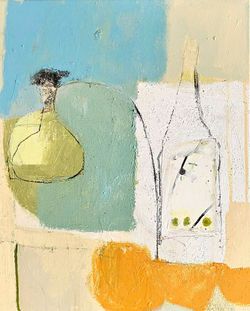 Tangiers[in Singapore] Mixed media on canvas, 54 x 44 x 3cm framed, £1,980 |  Ritual[in Singapore] Mixed media on canvas, 59 x 49 x 2cm framed, £3,420 |
|---|---|---|
 Patio Blues[in Singapore] Mixed media on canvas, 102 x 102 x 2cm unframed, £7,320 |  Chalice[in Singapore] Mixed media on canvas, 50 x 50 x 3cm framed, £3,300 |  Balance[in Singapore] Mixed media on panel, 49 x 49 x 5cm framed, £3,300 |
 Number Four[in New York] Mixed media on canvas, 115 x 94 cm unframed, £7,320 |  Beige Ground[in New York] Mixed media on canvas, 91 x 122 cm unframed, £7,320 |  Number Two[in New York] Mixed media on canvas, 115 x 94 cm unframed, £7,320 |
"Trying to describe Felice Hodges' wonderful paintings with accuracy can be difficult because - like the truest art - they transcend the harsh rigidities and conformities of language. She makes paintings that may first appear wholly abstract and gestural in expression but, on continued looking, are generally rooted in a specific place or moment which their titles and forms gradually reveal. They hover between abstraction and some mysterious, transformed poetic reality that the viewer becomes immediately caught up in and a part of, and the viewer becomes part of an interaction or dialogue with the picture itself. The evocative mood and atmosphere of these paintings is often suggested by subtle, ravishing harmonies of colour. Tones and colours are laid next to, or over each other, to create highly original and unexpected chromatic combinations which are also intensely beautiful. These have a direct effect on the viewer's emotions.
Felice trained as a musician and continues her musical interests and in this her work is reminiscent of the tone poems of Claude Debussy and Maurice Ravel. Such music is ethereal and free flowing, intangible, yet contained within a highly effective structure. Felice's paintings have a similar enigmatic character. The surface of these canvases is highly, richly complex, also like a musical composition. Felice contrasts the different textures and effects that derive from working paint with stiff and soft brushwork, bold gestures set against more contained ones. She combines acrylics with other media, and sometimes the paintings contain collaged elements.
I am reminded of another American resident of Chelsea, James McNeil Whistler, who gave musical titles to his paintings - Nocturne, Harmony, Arrangement - and which suppressed narrative in favour of evoking in his viewers delicate yet penetrating emotional states. They were the very first beginnings of abstract art in Britain. In her wonderful new exhibition Felice Hodges demonstrates the continued relevance and resonance of such an expressive approach to painting and perception, and it is one that enriches all who see it." – Robert Upstone, 2017. Former Director of The Fine Art Society and Head of Modern British Art at Tate Britain. He is now a specialist private dealer in Modern British Art.
Unheard Music
“The often-made analogy between music and abstract painting is especially apposite when considering Felice Hodges’ work, for in painting she aspires to the condition of music. Her early training was in classical piano, and rhythmic structures have long been crucial in her thoughts about art. The artist grew up in New York, where her mother was a concert pianist and teacher of piano, and where Hodges began her own studies on the instrument at the tender age of four. Later, she went on to study, firstly at the Royal College of Music in London, then at Cornell University in New York. Although she attained a very highly level of musicianship, she decided in her mid-twenties that the world of classical music was not for her, and switched courses, first studying art history at Cornell, then painting and sculpture in London. The transition came not entirely out of the blue, for Hodges had always been creative, and a passion for art was a constant in her family; her father collected German Expressionist works, and with him she visited galleries and museums from a young age. Now resident in England for over forty years, she began to operate fully as an artist in the 1990s, holding a first solo show in 2000, and exhibiting regularly ever since.
In a recent discussion, Hodges spoke of her recurrent use of certain motifs and phrases, comparing them to those of Beethoven and Bach, and referring to the latter's tight compositional structures, to his inventions, and the way in which he composed a series of works, each in a different key. Such considerations are brought to bear in Hodges' painting in which, within her sensuous handling of materials, one notes finely calibrated shifts in pitch and tempo, and exclamatory flourishes of staccato line and colour set against passages of calm delicacy. There is a great freedom of application, particularly evident in the larger work. Its ostensible insouciance results from periods of meditative concentration, followed by energetic bursts of painting, then assimilation, editing, reworking; for the intense discipline of her musical training is one she carries forward into her art. Small-scale pieces on paper -Teal Lights and Skiff for instance - are equally demanding, and necessitate a hands-on approach in which the thick paper substrate and collage elements become especially tactile and malleable.
Colour is central to Hodges, and she has over time gained a fearless confidence in its deployment. There are immensely subtle paintings here, formed largely from a limited tonal palette - Beige Ground is but one example - and also works in which large swathes of pure blacks and whites take precedence. In contrast are canvases such as Cathédrale Engloutie (titled after Debussy's poetic prelude for solo piano), in which a spired block of magenta and alizarin - the sunken cathedral of the composer's title - is partially submerged within a field of pale blue-grey. The rhythmic structures of the painting take their cue from those of Debussy's prelude.
While much of Hodges' work is comprised from an essentially abstract vocabulary of painterly gestures, loosely drawn shapes and signs, there is often an interplay between figuration and abstraction that ranges from the allusive to the explicit. Her motifs are frequently those of domestic objects: chairs and various types of vessels; vases, jugs, glasses. They serve both as compositional anchor points, and also metaphorically, grounding the work - and hence the artist - in both past and present. For time and the passage of time is another of Hodges' themes, and her vessels, be they drawn in outline, modelled in paint, or made from fragments of torn paper collage, symbolise not only present-day life, but also a history of human facture and usage stretching back to antiquity. In conversation the artist refers to the clay and alabaster vessels of ancient Egypt, containers of wisdom and secrets with which to journey to the afterlife. Such a notion is found in the still life Excavation, with its four forms set in an encrusted field of unbleached titanium, within which snippets of paper collage are submerged. And in fact, for Hodges the subject of archaeology is literally close to home, for her Dorset studio stands in close proximity to a site of excavation from which precious ancient artefacts were unearthed in the early twentieth century, and where Roman bricks remain in situ. The idea of time is also explored in two of the larger paintings shown here. Of equal dimensions, their titles - Fall, and Printemps - signify the dying back of autumn, and the renaissance of spring. Each is painted in diffuse stains and veils of dilute pigment. In both, warm ochres predominate, with greys, russet browns, and minor inflections of green and blues in Fall, and in Printemps a shimmering pale-yellow light and a single note of pink. Their atmospheric dynamics are spatially ambiguous, their variegated textures and earthy tones redolent of decaying frescoes. While these works clearly relate to the natural world, Hodges is at her most purely abstract in a series collectively titled Out of Left Field, based on American Colour Field painting. Mark Rothko is an obvious exemplar here, though Hodges also mentions the influence of Richard Diebenkorn's magisterial Ocean Park canvases. Several of the series are included here: Midnight Blue Eclipse, and Divide by Rust, are among them. Each formed of soft-edged panels and strips of colour, stacked either vertically or horizontally, these paintings demand of the viewer a pace of contemplation and engagement that is quite different to that of much else in Hodges' output. And in considering the full range of the artist's work, it is the ability to establish such a multiplicity of moods that becomes particularly striking; the orchestration of colour, scale, shape, line, and gesture, in the creation of a body of work that continues to develop to captivating effect.” – lan Massey, November 2022
Education: Royal College of Music (Scholarship)
BA (First) 1973-76 Art History, Cornell University, USA
Scheduled next solo shows 2027 at Cricket Fine Art, London and the Vanner Gallery, Salisbury
SOLO SHOWS
2024/solo show, Vanner Gallery, Salisbury
2024/“Milestones”, Cricket Fine Art, London
2023/“Under the Skylight”, Brian Sinfield Gallery, Burford, Cotswolds
2023/“Cadence”, McAllister Thomas Fine Art, Godalming, Surrey
2022/ Lemon Street Gallery, Truro, Cornwall
2022/“Twenty22”, Gallery at Home, Wales
2021/“Out of Left Field”, Cricket Fine Art, London
2020/“Palimpsest”, The Art Stable, Dorset
2020/“Twenty Recent Works”, McAllister Thomas Fine Art, Surrey
2019/“Inner Sanctum”, Cricket Fine Art, London
2019/“Synethesia”, Gallery at Home, Wales
2017/“Imagined Spaces”, Cricket Fine Art, London
2009-2026/ ‘Open Studios’ with Dorset Arts Weeks
2002/solo show “Recent Works”, Richmond Town Hall, Surrey
2000/solo show, “A River Runs Through it”, Orleans House Gallery,
Twickenham
SELECTED MIXED SHOWS
2024-2026 at the Vanner Gallery and all others
2023/ Vessels, the Vanner Gallery, Salisbury
2022/ London Art Fair (Lemon Street Gallery), Business Design Centre, London 2022/ Josie
Eastwood “Christmas Works”, Longbridge, Hampshire 2022/Gallery at Home, “Camaraderie”,
Wales
2022/ McAllister Thomas, various mixed, Godalming, Surrey
2022/ The Art Stable, various mixed, Dorset
2022/Alan Kluckow, Sunningdale
2022/ Lemon Street Gallery, Withiel and Rock, Cornwall
2021/ Lemon Street Gallery, Sculpture shows
2020-10/ Various at above galleries; art fairs at Royal College of Art, London;
Business Design Centre, London; Battersea Park, London
2005/ Babington House (Soho House), Somerset
2001/ Orleans House Gallery, Twickenham
1997/ Motcomb Street Gallery, London
PUBLICATIONS/CATALOGUES
“Under the Skylight”, accompanying catalogue to Brian Sinfield show
“Unheard Music”, Introduction by Dr Ian Massey
“Out of Left Field”, accompanying catalogue to Cricket show
“Imagined Spaces”, introduction by Robert Upstone
“Inner Sanctum”, introduction by Dr Ian Massey “Out of Left Field” catalogue for Cricket Fine Art
FT “How to Spend It”
Evening Standard
Dorset Magazine
“Richmond Faces” by Anna Purkiss
Homes and Gardens Magazine
Echo magazine
SELECTED COLLECTIONS
Richmond Borough Upon Thames
Twenty Grosvenor Square, London
Orleans House Gallery, Twickenham
Ten Castle Street, Dorset
Augusta and Co, London